Choosing the right cpvc fittings can determine whether a piping system remains dependable or develops costly weaknesses. A fitting may look simple, yet its size, connection method, pressure rating, and chemical compatibility matter greatly. Behind a wall, a poorly selected elbow can restrict flow, stress a joint, or create a slow leak that remains unnoticed for months.
Randy Knapp, a CPVC technical specialist associated with Lubrizol, has emphasized this practical principle: “Proper material selection and installation are essential to long-term piping performance.” That advice deserves attention. The strongest fitting is still vulnerable to excessive torque, uneven cutting, or unsuitable sealants. Small details matter.
This guide examines the top 10 types of CPVC fittings used in residential, commercial, and industrial piping. It covers elbows, tees, couplings, reducers, adapters, unions, and other useful connections. Each section will explain where the fitting belongs, what problem it solves, and which installation detail deserves caution. You may already recognize some of them. A few are often confused.
The list is useful, but it is not flawless for every project. Local codes, system temperature, pressure, and manufacturer instructions can change the best choice. A 90-degree elbow may save space, while two 45-degree elbows may provide smoother routing. That difference can matter near pumps, water heaters, or crowded service panels. Good planning is not dramatic. It is precise, visible, and repeatable.
What Are the Top 10 Types of CPVC Fittings?
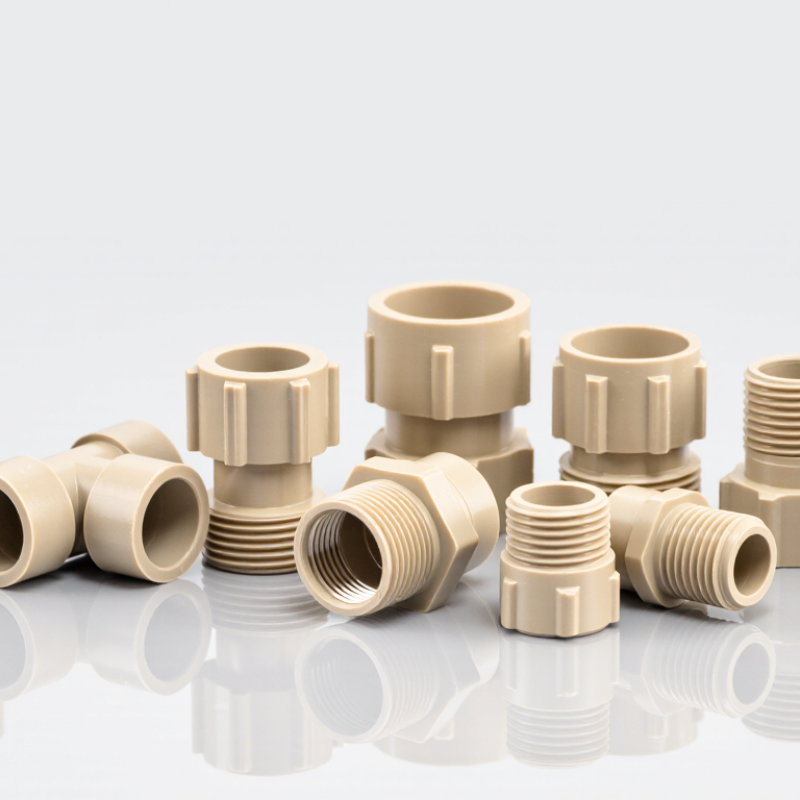
Common CPVC fittings include 90- and 45-degree elbows, tees, crosses, couplings, reducers, caps, plugs, unions, adapters, and flanges. Each changes flow direction, joins pipe, or helps connect equipment. ASTM F441 covers CPVC pipe in Schedule 40 and 80; ASTM F442 covers CPVC pipe made to SDR dimensions. These are pipe specifications, not a complete specification for every fitting. That distinction is easy to overlook.
A 180°F service limit is not a promise that every CPVC system can handle every pressure at that temperature. Allowable pressure generally decreases as temperature rises. Check the fitting and pipe ratings together, along with the system’s chemical compatibility and joining instructions. A threaded transition also needs care; overtightening can stress the plastic. Small details matter.
Tips: Check the rating. Confirm both temperature and pressure limits before installation. Keep cut ends clean, and follow the specified joining procedure. If the application is near 180°F, verify the complete system’s published limits rather than relying on a pipe marking alone. That extra check may feel cautious, but it can prevent a costly mismatch.
| No. | CPVC Fitting Type | Common Configurations | Primary Connection | Typical Application | Relevant Material or Product Standard | 180°F Service Consideration |
|---|---|---|---|---|---|---|
| 1 | 90° Elbow | Socket × socket; threaded × socket; threaded × threaded | Solvent-cement socket or tapered pipe thread | Changes the direction of a CPVC piping run by 90 degrees in hot- and cold-water systems. | Pressure-rated socket fittings are commonly covered by ASTM F438 or ASTM F439; threaded Schedule 80 fittings are covered by ASTM F437. The connecting pipe may conform to ASTM F441 or ASTM F442. | CPVC systems are commonly rated up to 180°F, but allowable pressure decreases as temperature rises. The complete system rating must be followed. |
| 2 | 45° Elbow | Socket × socket; threaded × socket | Solvent-cement socket or threaded connection | Provides a gradual 45-degree directional change and can help reduce abrupt flow redirection. | ASTM F438 or ASTM F439 for socket-type fittings; ASTM F437 for threaded Schedule 80 fittings; ASTM F441/F442 for compatible CPVC pipe dimensions and material classification. | Suitable for elevated-temperature service when the fitting, pipe, joining method, and pressure rating are all approved for the operating temperature. |
| 3 | Straight Tee | Equal-size run × branch | Three solvent-cement socket ends, or mixed socket/threaded ends | Creates a branch connection from a main CPVC line while maintaining the same nominal size. | Socket-type pressure fittings are generally specified under ASTM F439 or applicable system standards; ASTM F441 and ASTM F442 apply to compatible CPVC pipe, not to the fitting geometry itself. | At 180°F, verify the temperature-adjusted pressure rating and ensure the branch configuration is supported against thermal movement. |
| 4 | Reducing Tee | Larger run × smaller branch | Socket, threaded, or combination socket/threaded ends | Connects a smaller branch line to a larger main line without using a separate reducer and tee. | Commonly manufactured as CPVC pressure fittings under ASTM F439 or related applicable standards; connecting pipe may be ASTM F441 Schedule 40/80 or ASTM F442 SDR pipe. | Temperature derating is especially important where the smaller branch serves a high-demand fixture or equipment connection. |
| 5 | Coupling | Equal-size socket × socket; repair or slip configurations where permitted | Solvent-cement socket connection | Joins two sections of CPVC pipe in a straight line or supports a localized repair. | Pressure-rated socket couplings are commonly associated with ASTM F438 or ASTM F439; CPVC pipe may conform to ASTM F441 or ASTM F442, depending on the pipe dimension system. | Use only compatible CPVC cement and procedures approved for the service temperature. Cure time may need adjustment for temperature and joint size. |
| 6 | Reducer or Reducing Bushing | Concentric reducer; socket reducing bushing; threaded reducing bushing | Socket × socket, socket × thread, or thread × thread | Transitions between different nominal pipe sizes and adapts equipment or branch connections. | Socket pressure fittings are commonly covered by ASTM F439; threaded Schedule 80 fittings by ASTM F437. ASTM F441/F442 identify compatible CPVC pipe material and dimensional systems. | Confirm that the reduced section and any threaded interface have a pressure rating suitable for the temperature-adjusted design condition. |
| 7 | Male or Female Adapter | Socket × male thread; socket × female thread; flanged adapter options | Solvent-cement socket to threaded or flanged connection | Connects CPVC piping to metallic valves, tanks, pumps, water heaters, or other equipment with a different connection type. | Threaded CPVC fittings are commonly specified under ASTM F437 for Schedule 80 products; socket components may fall under ASTM F438 or ASTM F439. Pipe compatibility may be based on ASTM F441/F442. | Use compatible thread sealant and avoid over-tightening. Metal-to-CPVC transitions must account for thermal expansion and different material movement. |
| 8 | Union | Socket union; threaded union; combination socket/threaded union | Solvent-cement socket or threaded ends with a removable union nut | Allows pumps, valves, filters, heaters, and other components to be disconnected for maintenance without cutting the pipe. | Material and pressure requirements depend on the fitting design; ASTM F437, F438, or F439 may apply to relevant threaded or socket components. | Check the union gasket and sealing materials for continuous exposure to the intended temperature. Do not use the union nut to force misaligned piping together. |
| 9 | Cap or Plug | Socket cap; threaded plug; test cap where approved | Socket or threaded termination | Closes the end of a CPVC pipe run, branch, drain point, or temporary test section. | Socket and threaded versions are selected under the applicable CPVC fitting standard, commonly ASTM F438, F439, or F437. ASTM F441/F442 apply to compatible pipe products. | Temporary test components must be rated for the test pressure and temperature. A cap or plug must not be used beyond its listed pressure-temperature limits. |
| 10 | Cross | Four equal-size ports; reducing branch configurations | Four socket ends or mixed socket/threaded ends | Provides two branch connections from a main line, commonly used where several distribution paths meet. | Where manufactured as pressure-rated socket fittings, the applicable product requirements are generally associated with ASTM F439 or the governing piping system standard. | Use carefully in high-temperature service because multiple branches can increase stress, movement, and support requirements. Confirm the temperature-adjusted pressure rating. |




© Copyright 2025 PolyFab Plastic Industry LLC. All Rights Reserved.

