Home // Blog
Global buyers rarely choose a PVC pipe supplier by price alone. Consistent dimensions, reliable resin quality, clear technical documentation, and realistic delivery times matter just as much. A container may look perfect at the port. The real test comes when crews cut, join, and install the pipes. Small differences can cause costly delays.
This guide examines 8 pvc pipe suppliers through practical sourcing questions: What products do they offer? Can they support repeat orders? Are test documents and product specifications easy to review? How clearly do sales teams explain production capacity and shipping timelines? Buyers should also confirm that each product suits its intended application and meets the requirements of the destination market. Details vary. A polished website alone proves very little.
Suggested expert quotation—replace with a verified statement before publication: “A supplier’s real value shows in repeatable quality, traceable testing, and honest delivery commitments.” — [PVC industry expert’s verified name and credentials]. The comparison is intended as a starting point, not a guarantee that one supplier fits every project. Some details may change between orders, and public information can be incomplete. That is worth remembering. Request current specifications, samples where practical, and written confirmation of key terms before making a decision.
PVC-U is rigid, unplasticized polyvinyl chloride, commonly used for water mains, irrigation, pressure drainage, and sewer lines. PVC-O is molecularly oriented PVC, designed to improve strength and impact performance; PVC-C is chlorinated PVC, often selected for warmer fluids. They are not interchangeable. Check the applicable product standard, dimensions, joint type, and temperature limits before comparing supplier quotes. For water-service pipes, ISO 1452 sets requirements for PVC-U systems, including pressure-rated applications.
Pressure class matters. PN 10 and PN 16 are common ratings, but the usable pressure depends on pipe dimensions, temperature, fittings, and installation conditions. AWWA Manual M23 describes a 100-year design basis for PVC pressure pipe; that is a design assumption, not a guarantee for every buried line. A useful detail: confirm whether a quote specifies nominal pressure at reference temperature and includes matching fittings. A mismatch can undermine an otherwise sound system. PVC-U is light to handle, but sharp stones under the barrel or poor joint alignment can still cause trouble. Test the full system. Then document the result—buyers sometimes overlook that step.
Selected nominal pressure ratings for PVC-U pipes at the 20°C reference temperature.
PN is the nominal pressure class, expressed in bar. Higher PN classes indicate higher rated pressure under reference conditions. The suitable class depends on the applicable standard, pipe dimensions, temperature, and system design; pressure capacity may decrease as operating temperature rises.
For global buyers, ISO 1452 and ASTM D1785 describe different systems, not interchangeable labels. ISO 1452-2 specifies PVC-U pipe for pressure applications, with dimensions organized around nominal outside diameter and pressure classes. ASTM D1785 covers Schedule 40, 80, and 120 pipe. Its dimensions use nominal pipe size and wall thickness. Check the standard named on the supplier’s certificate.
The difference is visible in a common 2-inch pipe. ASTM D1785 lists an outside diameter of 2.375 inches; wall thickness is 0.154 inch for Schedule 40, 0.218 for Schedule 80, and 0.250 for Schedule 120. These figures come from the standard’s dimensional tables. More wall thickness does not automatically mean a better choice. Pressure, temperature, fluid, and connection design matter. Small difference. Real consequence.
When evaluating suppliers, request the applicable standard, dimensional inspection records, and batch traceability. Ask whether the quoted pressure rating reflects the operating temperature; PVC pressure capacity can decrease as temperature rises. ISO pressure classes and ASTM schedules should not be compared by name alone. The Plastics Pipe Institute’s Handbook of PVC Pipe Design and Construction provides further engineering guidance on PVC pipe design. Verify exact requirements against the project specification and current standard editions. A missing certificate detail can delay installation, even when the pipe looks right.
Eight practical supplier qualification criteria for evaluating PVC-U pipe sourcing. This is a buyer’s checklist, not a ranked list of companies.
| No. | Supplier qualification area | What to verify | Why it matters to global buyers |
|---|---|---|---|
| 1 | Standards coverage | Confirm the offered PVC-U pipe is manufactured and tested to the applicable product standard: ISO 1452 for PVC-U piping systems, or ASTM D1785 for PVC plastic pipe in Schedules 40, 80, and 120. Check the exact standard edition and product scope. | Standards are not interchangeable; the buyer’s project specification and destination-market requirements determine which one applies. |
| 2 | Dimensions and tolerances | Request dimensional tables and inspection records for nominal size, outside diameter, wall thickness, length, and applicable tolerances. For ASTM D1785 products, verify the specified schedule and size. | Schedule identifies a pipe dimension series; compatible fittings and joining methods must match the relevant standard and dimensions. |
| 3 | Pressure and temperature suitability | Ask for the pressure rating for the exact pipe size, material, and standard, along with any temperature-related derating guidance. Do not infer a pressure rating from “Schedule 40,” “Schedule 80,” or “Schedule 120” alone. | Allowable working pressure depends on the product dimensions, material, temperature, and applicable design requirements. |
| 4 | Material and application documentation | Obtain the material specification and written confirmation that the pipe is suitable for the intended service. For drinking-water use, verify the approvals or regulatory acceptance required in the destination jurisdiction. | A general PVC-U product standard does not by itself establish every local approval or suitability for every fluid and application. |
| 5 | Quality control and testing | Review the supplier’s inspection plan and request relevant test reports, such as dimensional checks and the tests required by the specified product standard. Confirm how nonconforming products and corrective actions are handled. | Documented controls and product-specific test evidence help buyers assess consistency and conformance. |
| 6 | Traceability and marking | Check that pipe markings and batch records identify the information required by the applicable standard and purchase specification, such as manufacturer identification, nominal size, material, and standard reference where required. | Traceable markings support receiving inspection, documentation checks, and investigation of quality issues. |
| 7 | Fittings and joining compatibility | Confirm the proposed fittings, sockets, and joining method are compatible with the pipe standard, dimensions, and intended service. Request installation guidance and the applicable joining procedure. | A pipe and fitting system must be compatible as a complete assembly; matching nominal size alone may not be sufficient. |
| 8 | Export and delivery readiness | Agree on packaging, bundle protection, shipment quantities, delivery terms, lead time, and export documents before ordering. Specify destination, unloading constraints, and any required inspection or certificate documents. | Clear logistics requirements reduce the risk of transit damage, documentation delays, and delivery mismatches. |
Note: Always confirm the current edition of the referenced standard and the project’s applicable codes, approvals, and purchase specifications before placing an order.
SDR means outside diameter divided by wall thickness. Both measurements must use the same units. Units must match. For a pipe with a 110 mm outside diameter and a 5.3 mm wall, the ratio is about 20.8. The applicable product standard determines how that value is designated. A lower SDR generally indicates a thicker wall relative to the pipe’s diameter, but it does not tell the whole performance story.
When comparing supplier data, check that outside diameter and minimum wall thickness refer to the same product specification. A rounded SDR can hide small differences, so review the stated dimensions and tolerances too. Ask for a technical datasheet that identifies the material, test basis, and intended service conditions. Temperature and fluid pressure can affect suitability. SDR alone is not a pressure rating.
This ratio is useful for comparing pipe designs across catalogs, especially when dimensions are presented in different units. Still, it is easy to trust the number too much. One calculation cannot confirm compatibility with fittings, installation loads, or project requirements. I would verify those details before ordering, even when the supplier’s table looks clear. A quick check helps, but the design context matters.
For global buyers comparing PVC pipe suppliers, a 50-year performance figure deserves careful reading. ISO 9080 uses long-term hydrostatic test data to statistically extrapolate the strength of thermoplastic pipe material under sustained pressure. Tests involve pipes exposed to controlled internal pressures, often at different temperatures. The results help estimate long-term strength; they do not observe every pipe operating for five decades.
Ask suppliers for the applicable test report and confirm that its material, dimensions, and product construction match the pipes being offered. A report for one formulation should not automatically be treated as evidence for another. Check how the stated design basis relates to the pipe’s pressure class and intended service temperature. Small details matter.
A test report is not a promise. Actual service life can be affected by installation quality, temperature changes, pressure surges, chemical exposure, and joint performance. A scratched pipe dragged across gravel, for example, may face conditions absent from a laboratory test. The 50-year extrapolation is useful evidence, but it is still an estimate with assumptions. Buyers should ask what those assumptions are—and whether the supplier can explain them plainly.
Comparing eight PVC pipe suppliers requires more than matching quoted prices. Start with certification, but check the document’s scope, issuing body, and expiry date. A certificate for one pipe type may not cover another.
Paperwork matters.
Ask each supplier for recent test reports tied to the diameter, pressure rating, and intended application you need. Then compare the details, not just the logos on a document.
Capacity needs evidence, too. Request monthly output by product range, current production lead time, and a sample schedule for a repeat order. A large factory may still have limited availability in a specific size.
If possible, arrange a video walkthrough or independent facility audit.
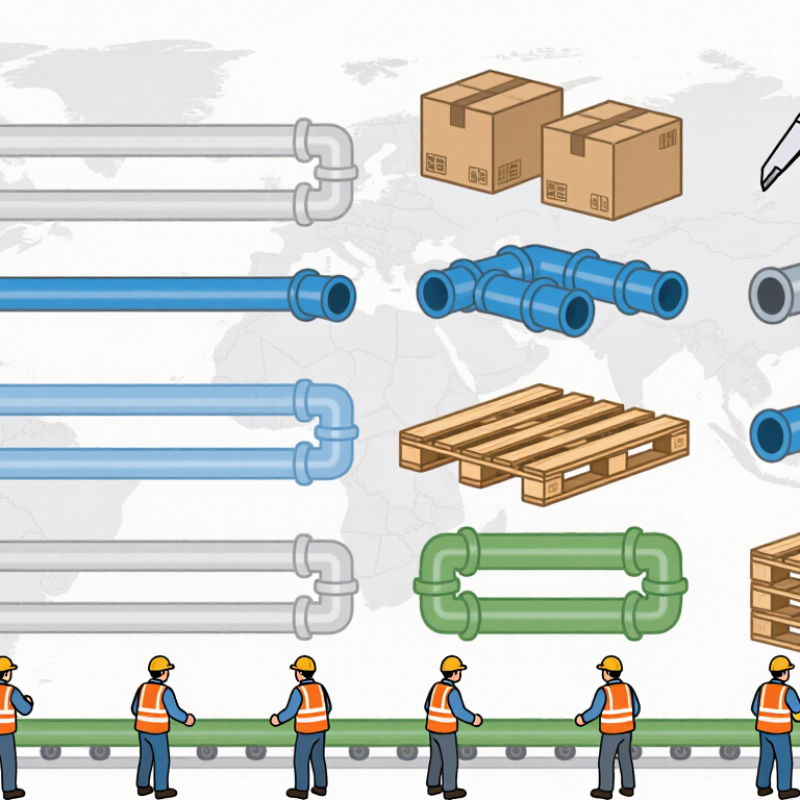
Export reach is equally practical: ask which regions the supplier serves regularly, which ports it ships through, and whether it can provide packaging suited to long-distance transit. Review sample shipping records with sensitive commercial details removed. A broad destination list can sound impressive, but it does not prove reliable delivery.
I would treat any comparison table as a working tool, not a verdict; production and freight conditions change. Keep the same questions for all eight suppliers, record unanswered items, and verify claims before committing.
© Copyright 2025 PolyFab Plastic Industry LLC. All Rights Reserved.