Why Choose an Automatic Circuit Recloser?
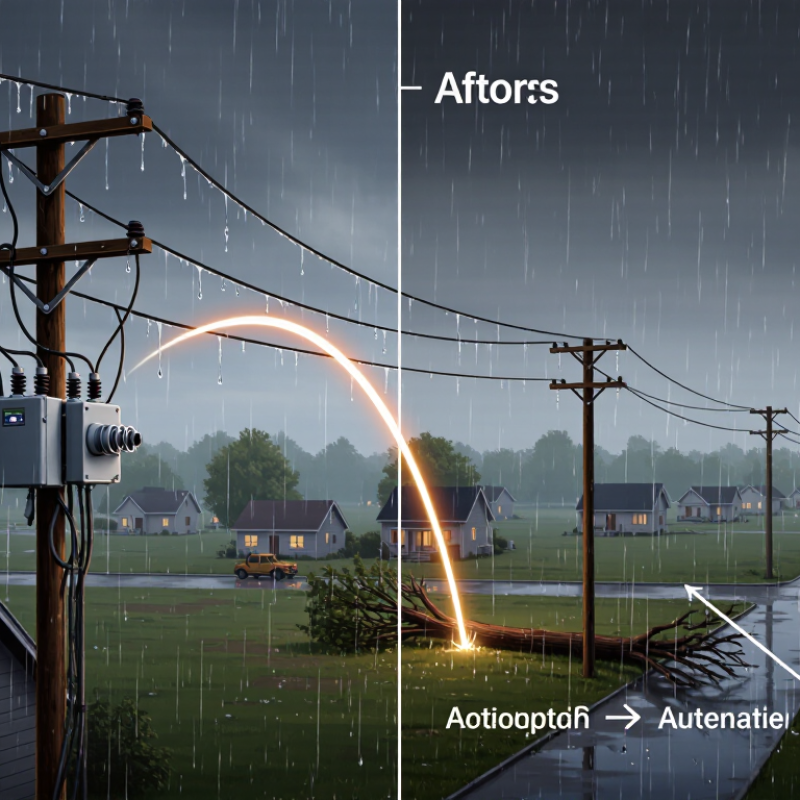
A storm-darkened feeder can leave homes without power after a branch touches a wet line. An Automatic Circuit Recloser detects fault current, opens the circuit, and attempts to restore service after a brief pause. If the fault has cleared, lights may return without a crew visiting the site. That pause matters. It can separate a temporary branch contact from a lasting cable fault.
The U.S. Energy Information Administration’s 2022 Form EIA-861 data reported an average of about 5.5 hours of electricity interruptions per customer, including major events; excluding them, the average was about 2.5 hours. These figures show why utilities track reliability measures such as interruption duration, while also reminding us that weather and local network conditions matter. A recloser can help limit the reach and duration of some feeder faults, but it cannot prevent every outage or repair damaged equipment. Practical value depends on protection settings, coordination with upstream devices, and the actual fault levels on the line. IEEE Std 1366 gives utilities a common framework for measuring distribution reliability. The decision still needs local engineering judgment. Not every feeder needs one. A careful assessment should weigh outage history, customer criticality, maintenance access, and the cost of communications and control equipment before choosing an Automatic Circuit Recloser.
Automatic Circuit Reclosers: Their Role in Medium-Voltage Distribution Networks
Why Choose an Automatic Circuit Recloser?
Automatic Circuit Reclosers: Their Role in Medium-Voltage Distribution Networks
On a medium-voltage feeder, a tree branch or brief lightning surge can cause a temporary fault. An automatic circuit recloser detects abnormal current, opens the circuit, then attempts to restore service after a short interval. If the fault has cleared, power returns without a crew visiting the site. Not every fault clears. For a persistent fault, the recloser can open again and eventually lock out, limiting damage and helping protect the wider network.
Tips: Set recloser operations to coordinate with nearby protective devices. Check fault records and settings during routine maintenance. A setting that works on paper may need adjustment after feeder changes.
Reclosers can reduce the number of customers affected by short interruptions, especially on long rural lines with frequent exposure to weather or vegetation. Their value depends on correct placement, protection settings, and communication with other equipment. They are not a shortcut around careful engineering. Poor coordination may disconnect a larger section than necessary, and repeated interruptions can still trouble sensitive loads. In practice, reviewing event logs after storms can reveal whether the chosen settings match real feeder conditions. Even then, interpretation takes care.
Why Choose an Automatic Circuit Recloser? - Automatic Circuit Reclosers: Their Role in Medium-Voltage Distribution Networks
| Network Aspect | How an Automatic Circuit Recloser Works | Why It Matters |
| Temporary faults | After detecting a fault and opening its contacts, a recloser can automatically close again according to its configured operating sequence. | Many overhead-line faults are temporary, so service may be restored without a field crew having to reset the device. |
| Permanent faults | If the fault remains after the permitted reclose attempts, the device opens and can enter lockout until the fault is investigated and the equipment is reset. | Repeatedly energizing a persistent fault is avoided, helping limit equipment damage and improve safety. |
| Protection coordination | Protection settings and operating sequences can be coordinated with upstream and downstream protective devices. | Coordination helps isolate the affected section while keeping as much of the remaining distribution network in service as possible. |
| Fault isolation | Reclosers can be installed at selected points along a feeder to divide it into protection zones. | A fault may be confined to a smaller part of the feeder, reducing the number of customers affected. |
| Monitoring and control | Depending on the equipment and system design, controls can record events and measurements and support remote monitoring or operation. | Operational data can help utilities assess faults and manage network response without relying solely on on-site inspection. |
| Installation context | Reclosers are commonly used on medium-voltage distribution feeders, including overhead networks; the appropriate design depends on the installation. | They provide an automated protection option at feeder locations where fault interruption and restoration functions are required. |
| System suitability | Voltage, continuous-current, interrupting, insulation, and protection requirements must be selected to suit the specific network and applicable standards. | Correct ratings and coordination are essential; there is no single recloser configuration suitable for every distribution system. |
Actual operating sequences, ratings, and available functions vary by application and system design. Protection settings should be determined through an engineering study.
How Fault Detection and Up to 4 Reclosing Shots Restore Power
Why Choose an Automatic Circuit Recloser?
How Fault Detection and Up to 4 Reclosing Shots Restore Power
An automatic circuit recloser monitors current on an overhead feeder. When it detects a fault, it opens the circuit to stop current flow. A brief pause follows. If a branch has brushed the line or lightning caused a temporary arc, the fault may clear before the recloser closes again. Some settings allow up to four reclosing shots. If the fault persists, the device locks out and keeps the affected section isolated. Four attempts are not a promise of restoration; they are a controlled sequence.
The IEEE Guide for Automatic Reclosing of Circuit Breakers, IEEE C37.104, covers timing and coordination. IEEE Std 1366-2022 defines a momentary interruption as lasting five minutes or less, providing a consistent reliability measure. That threshold is useful context, not a guarantee that every interruption will be brief. A damaged cable or fallen conductor may require inspection and repair. Protection settings also need to match the feeder and connected equipment.
Tips: Confirm the shot count and time delays with a qualified protection engineer. Check coordination with downstream devices. Small setting differences matter. A recloser can restore service quickly, but poor coordination can interrupt more customers than necessary.
IEC 62271-111: Recloser Requirements for Systems up to 38 kV
Why Choose an Automatic Circuit Recloser?
IEC 62271-111: Recloser Requirements for Systems up to 38 kV
Automatic reclosers help restore service after temporary faults, such as a brief contact between a branch and an overhead line. IEC 62271-111 sets requirements for reclosers used on alternating-current systems above 1 kV and up to 38 kV. It addresses equipment performance, ratings, and testing. That matters when a device must interrupt fault current, then close again in a controlled sequence. Small timing differences can affect coordination with nearby protection equipment.
When evaluating a recloser, check that its rated voltage and fault-interrupting capability suit the actual network. Review the specified operating sequence, insulation requirements, and environmental conditions against the installation site. A unit that meets the standard still needs correct protection settings and coordination with upstream and downstream devices. Standards guide selection; they cannot account for every feeder’s operating history or future load changes. Field conditions can be less tidy than design documents suggest.
Tips: Confirm the applicable edition of IEC 62271-111, and compare test documentation with your project requirements. Ask how settings will coordinate with existing devices. Don’t assume a compliant rating alone guarantees a good fit.
Key Ratings: Voltage, Interrupting Capacity, and Operating Sequence
Why Choose an Automatic Circuit Recloser?
Key Ratings: Voltage, Interrupting Capacity, and Operating Sequence
Voltage rating must match the system’s maximum operating voltage, not just its nominal label. Check insulation level, grounding, and altitude conditions; a mismatch can compromise clearance or equipment life. Interrupting capacity is equally important. It must exceed the highest fault current expected at the installation point, with the rating stated on the same basis as the protection study. Small margins matter. IEEE C37.60 defines requirements for high-voltage reclosers, giving engineers a consistent framework for comparing ratings.
Operating sequence determines how the recloser responds to repeated faults. A typical sequence may include fast and delayed trips, followed by lockout, but timing and shot count must coordinate with fuses, relays, and neighboring devices. Confirm the specified open and close intervals against the actual control settings; a sequence that looks suitable on paper may not coordinate in the field. That detail is easy to overlook.
Reliability figures offer context, not a direct prediction of recloser performance. The U.S. Energy Information Administration’s Electric Power Annual reports system-level interruption measures such as SAIDI, which tracks average interruption duration. These figures do not isolate recloser effects. Use local fault records and a short-circuit study to select ratings, then verify the complete sequence during commissioning. The study may still miss unusual conditions. That is worth reviewing.
How Protection Coordination Helps Isolate Faults and Maintain Service
An automatic circuit recloser detects abnormal current and opens a feeder to interrupt it. On an overhead line, a branch may brush a tree during a gust, causing a brief fault. The recloser pauses, then closes again according to its settings. If the fault has cleared, customers may see only a short interruption. If it remains, the device can open again and eventually lock out the affected section.
Protection coordination decides which device should respond first. A downstream fuse or recloser should normally clear a fault on its own branch before an upstream device interrupts a larger area. Engineers compare operating curves and timing so the devices have room to act in the intended order. When coordination works, a fault near one roadside transformer is less likely to cut power to an entire feeder. That selectivity matters.
It takes careful study. Engineers check expected fault current, load changes, grounding, and equipment limits, then review settings against field conditions. A neat coordination study can still miss details, such as a changed feeder configuration or unexpected load growth. Field conditions can be less tidy. Periodic checks help confirm that settings remain suitable and that a recloser’s operating sequence supports both equipment protection and reliable service.
Why Choose an Automatic Circuit Recloser?
Protection coordination helps a recloser isolate a fault while giving temporary faults a chance to clear before upstream protection operates.
Example sequence timings in seconds—not universal settings. A fast trip interrupts fault current; the reclose dead time is the interval before the recloser closes again. If a fault persists, a delayed trip can isolate it, while upstream backup protection is coordinated to allow the downstream recloser to act first. Actual settings depend on system studies and equipment.

