What Are the Top Types of EV Resistors?
Electric vehicles depend on controlled electrical energy, not only powerful batteries and efficient motors. An Ev Resistor helps manage that energy during charging, startup, braking, heating, and fault protection. Its role may seem modest, yet a poorly selected resistor can create excessive heat, unstable voltage, or premature system failure.
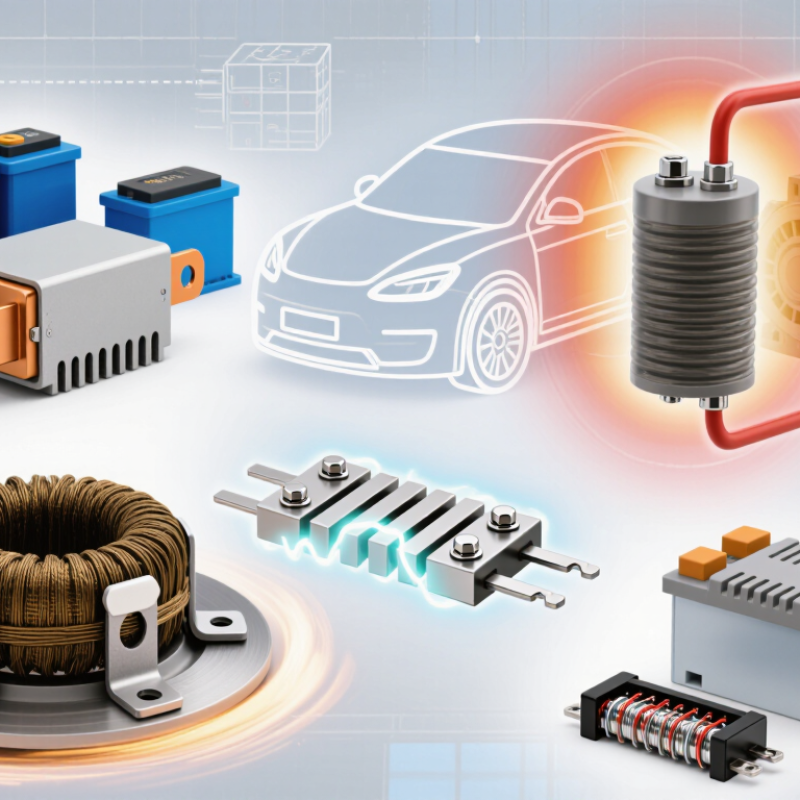
John D. Kelly, a veteran automotive power-electronics engineer, states, “A resistor is simple only until heat, voltage, and time arrive together.” This practical observation frames our discussion. The main categories include pre-charge resistors, dynamic braking resistors, discharge resistors, current-sensing shunts, and high-power load resistors. Each type faces different demands. A pre-charge resistor limits the initial current entering an inverter’s capacitors. A braking resistor absorbs surplus energy during regenerative braking. A discharge resistor safely removes stored voltage after shutdown. Small details matter here. Temperature, pulse duration, insulation, vibration, and mounting space all affect performance.
The best Ev Resistor is not always the largest or most expensive option. Engineers must match resistance value, peak power, continuous power, voltage rating, and cooling method. Liquid cooling may suit compact battery systems, while air-cooled aluminum housings can work well in less demanding locations. Testing should include repeated start cycles, emergency stops, and hot-soak conditions. Real vehicles rarely behave like laboratory diagrams.
Some choices remain imperfect. Cost targets can encourage undersizing, while conservative designs add unnecessary weight. That tension deserves attention. This guide examines the top EV resistor types, their operating principles, selection criteria, common failure risks, and practical installation considerations.
What Are EV Resistors and Why Are They Important?
What Are the Top Types of EV Resistors?
What Are EV Resistors and Why Are They Important?
An EV resistor controls electrical energy as heat within high-voltage systems. It limits current, protects circuits, and supports safe energy release.
Small component. Serious duty.
The pre-charge resistor is essential during startup. It gradually charges the inverter’s DC-link capacitors before the main contactors close. Without this step, sudden inrush current could damage contacts, fuses, or power electronics. A discharge resistor safely removes stored voltage after shutdown. This reduces shock risk during service, although real-world maintenance procedures still need improvement.
Dynamic-braking resistors absorb excess energy when batteries cannot accept more regenerative power. They are more common in commercial, off-road, and high-load electric systems. Heating resistors supply cabin heat when an efficient combustion engine is absent. High-voltage load resistors also support testing, balancing, and controlled energy dissipation.
The need for dependable designs is growing. The International Energy Agency reported nearly 14 million electric cars sold globally in 2023, representing about 18% of new car sales. BloombergNEF’s 2023 Battery Price Survey recorded a 14% drop in average battery-pack prices, reaching 139 dollars per kilowatt-hour. More vehicles and denser systems mean greater thermal demands. Resistor selection must consider voltage, pulse duration, cooling, insulation, and failure behavior.
One rating is never enough. That assumption can fail.
How Are EV Resistors Classified by Their Functions?
What Are the Top Types of EV Resistors?
How Are EV Resistors Classified by Their Functions?
EV resistors are best classified by what they control, not only by resistance value. Pre-charge resistors limit the current entering the inverter’s DC-link capacitors. This reduces electrical surges during startup. Discharge resistors safely drain stored energy after shutdown. They support maintenance safety, although their timing and heat capacity need careful verification.
Braking resistors convert excess regenerative energy into heat when the battery cannot accept more power. Heating resistors support cabin comfort and battery-temperature control in cold conditions. Current-sensing resistors provide precise voltage signals for monitoring circuits. Some assemblies also use snubber resistors to reduce switching spikes. A neat classification is useful, but real modules can overlap. A pre-charge unit may also require strong pulse resistance.
The International Energy Agency reported nearly 14 million electric car sales in 2023. This growing fleet increases demand for reliable high-voltage components. ISO 16750 testing commonly guides evaluation for vibration, thermal changes, and electrical loads in road vehicles. However, resistor selection still depends on duty cycle, coolant flow, insulation, and installation space. Experience shows that a low resistance value alone proves little.
Tips: Check pulse power, continuous power, maximum temperature, and isolation distance. Review worst-case battery voltage. Do not treat laboratory cooling as real vehicle cooling. Small design assumptions can become expensive failures.
What Are the Main Types of EV Resistors?
Electric vehicle resistors are grouped by their electrical purpose, heat load, and position in the power system. The main types include pre-charge resistors, braking resistors, discharge resistors, and current-sensing resistors. Each type solves a different control or safety problem. Pre-charge resistors limit the sudden inrush current when a battery connects to an inverter. This protects capacitors and reduces contact stress inside high-voltage switching equipment.
Braking resistors absorb excess energy during regenerative braking when the battery cannot accept more charge. They convert that energy into heat, so cooling and pulse-rating data matter greatly. Discharge resistors safely drain stored voltage from capacitors after shutdown. Technicians check discharge time with suitable test equipment, not by assumption. Current-sensing resistors, often called shunts, create a tiny voltage drop for accurate current measurement. Their resistance is low, but their accuracy requirements are demanding.
Construction also separates resistor types. Wire-wound designs handle high energy, while thick-film and metal-element designs can offer compact sensing or switching solutions. Some EV systems use liquid-cooled resistor assemblies. That detail is easy to overlook. In practice, resistor categories can overlap, and a simple label may mislead. A pre-charge resistor still needs pulse endurance, insulation, temperature control, and stable resistance. Engineers should verify voltage, current, energy, operating duration, cooling conditions, and fault behavior before selecting a component. Datasheet values are essential, but real vehicle testing can reveal vibration, heat, and connection problems that calculations miss.
What Are the Main Types of EV Resistors?
EV resistors are selected according to their resistance value, current level, pulse energy, and thermal duty cycle. The chart shows representative resistance ranges commonly used in electric-vehicle power electronics; actual values vary by vehicle architecture and design requirements.
How Should the Right EV Resistor Be Selected?
Selecting the right EV resistor starts with its job, not its catalogue size. Pre-charge resistors limit inrush current when high-voltage capacitors charge. Discharge resistors safely reduce stored voltage after shutdown. Braking and load resistors absorb short bursts of regenerative energy. Each type faces different electrical and thermal stress.
The IEA’s Global EV Outlook 2024 reported nearly 14 million electric cars sold worldwide in 2023, representing about 18% of new car sales. Higher volumes make reliable resistor selection less forgiving.
Measure the maximum system voltage, expected current, pulse duration, and switching frequency. For a pre-charge resistor, estimate peak power with P = V²/R, then check the pulse-energy rating. A resistor can survive one pulse and still fail during repeated cycles.
Thermal design matters. Leave space for airflow, use temperature sensing where practical, and examine derating curves above 25°C. Insulation, creepage distance, vibration resistance, and moisture protection also deserve attention. IEC 60115 provides a useful framework for fixed resistor reliability, while ISO 16750 addresses electrical and environmental loads in road vehicles.
The U.S. Department of Energy’s Electric Drive Technologies reports emphasize efficiency and thermal management as key EV development priorities.
Do not select resistance from voltage alone. A slightly higher value may reduce inrush, but it can extend charging time. That trade-off is easy to underestimate. Testing with real cables, capacitors, and control timing remains necessary, because laboratory assumptions can be too clean.

