Top 10 Patterned Play Mats for Kids in 2026

A play mat can turn a bare floor into a small world: roads for toy cars, shapes to name, or a soft place for tummy time. Yet a bright print alone does not make a mat safer or more useful. Circana’s 2024 global toy-market review reported a 2% sales increase across 12 tracked markets, showing continued interest in play products—but it does not measure play mats specifically. That distinction matters when shopping.

The American Academy of Pediatrics’ clinical report, “The Power of Play” (2018), describes play as important to young children’s development. WHO guidance for children under five also emphasizes active play and limiting sedentary time. Neither report says a patterned mat guarantees developmental gains. It can, however, offer a defined surface for movement and imaginative play. Small details count: a road print that invites pretend driving, a clear alphabet for naming letters, or a surface that wipes clean after snack time. Not every design works for every home.

This 2026 guide compares ten options through practical considerations, including pattern clarity, cushioning, grip, cleaning, and age suitability. A Patterned Children Play Mat should fit the child’s routines and the room, not just the product photo. We also look for product specifications that parents can verify. Some listings leave useful details unclear; that deserves a second look. A cheerful design helps. It is not the whole story.
Top 10 Patterned Play Mats for Kids in 2026

What Patterned Play Mats Are and How Children Use Them

Patterned play mats are soft, floor-level surfaces printed with shapes, roads, animals, letters, or simple scenes. The design can give a child something to notice while they sit, crawl, build, or play. A winding road may invite toy cars; colored circles can become places to jump or sort blocks. Some children enjoy naming pictures or making up stories around them. Others barely notice the print. That is normal.

At home, caregivers can use a mat to define a play area and make floor activities feel more inviting. A few blocks, washable toys, or picture books are often enough; the pattern need not dictate the game. For younger children, stay close and choose age-appropriate toys, since mats do not replace supervision. Check that the surface lies flat, and follow its cleaning instructions. If it becomes cracked, peeling, or unusually slippery, stop using it until you can assess it. Busy patterns can also distract some children, especially during quiet play. A calmer design may work better. Honestly, choosing the “right” print is partly trial and error: watch how the child uses the space, then adjust. Small details matter.

Materials, Safety Standards, and Construction Features to Check

A patterned play mat should feel firm, stable, and easy to clean, not merely soft underfoot. Foam, textile, and rubber surfaces can differ in odor, grip, and cleaning needs. Ask for material-specific test records, especially for accessible coatings and printed designs. For products sold in the United States, check applicable requirements such as ASTM F963 and CPSIA limits; compliance claims should be traceable to the exact model, not just a factory’s general certificate.

Construction matters at floor level. Press along the edges: loose seams, peeling layers, or sharp corners can become hazards. Check that the underside resists sliding on your own floor, and inspect folding hinges or interlocking joints for gaps where small fingers could catch. The CPSC’s 2023 toy-injury report estimated 231,700 emergency-department-treated injuries involving toys; it does not identify play mats as the cause, but it underscores why product-specific checks matter. A thicker mat is not automatically safer.

Look for clear age guidance, cleaning instructions, and batch or model identification. If a seller cannot provide test documentation, that is a reason to pause. I would still treat labels cautiously: a neat pattern and reassuring claims cannot show how a mat wears after months of scrubbing and play.

Top 10 Patterned Play Mats for Kids in 2026: Materials, Safety Standards, and Construction Features to Check

U.S. material limits to check when a play mat is classified as a children’s product

These are regulatory limits, not product ratings: U.S. rules generally limit lead to 100 ppm in accessible children’s product components and 90 ppm in paint or similar surface coatings. For covered children’s toys and child-care articles, each of eight specified phthalates is limited to 0.1% (1,000 ppm). Whether a particular mat is covered depends on its classification and use. Ask for applicable test documentation, and check material, seams, backing, and printed surfaces.

How Colors and Patterns Support Play, Learning, and Movement

2026
Top 10 Patterned Play Mats for Kids in 2026

Colors and patterns can turn a floor mat into an inviting place to move, notice, and explore. A path of dots may encourage a toddler to step from one shape to another. A simple grid can inspire block-building or sorting games. High-contrast designs may be easier for some children to notice, though preferences vary with age, vision, and sensory needs. Keep the pattern clear enough that toys and small details remain visible. A busy print can look cheerful, but it may also distract some kids. I still find that a child’s reaction is hard to predict from a product photo.

Tips: Match the design to the play. Try tracing lines with a finger, naming colors, or hopping between shapes. Choose a mat that lies flat and has a wipeable surface. Check its size against the play area, too.

Patterns can support movement when they suggest routes, targets, or places to pause. Leave open space for rolling, stretching, and imaginative play. Sit nearby and follow your child’s lead; a printed road might become a river instead. That change is part of the fun. Look for clear care instructions, a stable fit on your floor, and materials suited to the child’s age. No mat teaches on its own, but a thoughtful pattern can offer an easy starting point for shared play.

Ten Patterned Play Mats for Kids to Consider in 2026

A road-map mat can turn toy cars into a small neighborhood, while an animal-print design gives toddlers familiar shapes to point at. Alphabet patterns invite casual letter games, and geometric grids offer older children room to build with blocks. Look for clear printing that stays readable without overwhelming the play area. Small details matter.

A garden pattern with leaves and insects brings gentle color; an ocean scene adds fish, waves, and space for pretend play. City-street designs suit train or vehicle toys, while weather motifs can spark simple conversations about clouds and rain. A muted checkerboard may fit a shared living room better than a bright, busy print. Still, inspect the edges.

For a more tactile look, consider mats with large, distinct shapes or contrasting zones. Pattern alone is not enough: check the care instructions, surface texture, and whether the mat fits the intended floor space. A product photo can hide thin construction or curled corners, so read dimensions and material details carefully. I would not assume every colorful mat is easy to clean. Choose a design your child enjoys, but leave enough open space for safe movement and scattered toys.

Top 10 Patterned Play Mats for Kids in 2026 - Ten Patterned Play Mats for Kids to Consider in 2026

A style-focused guide to patterned play mat designs, with practical points to consider when choosing one for your home.

No. Pattern Style Visual Design A Good Fit For Practical Consideration What to Check Before Buying
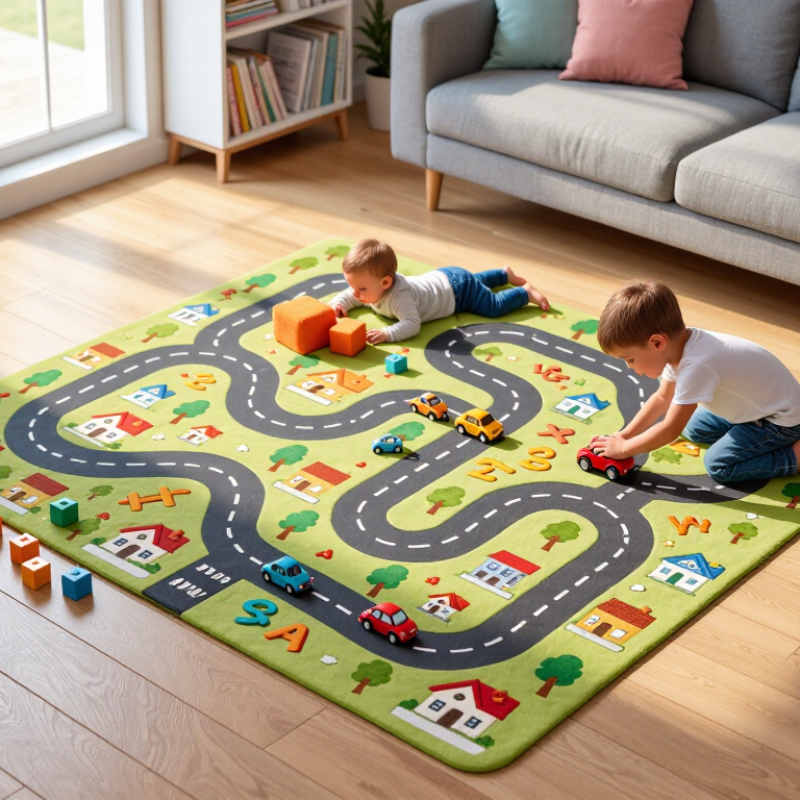
01 Road and Town Map Roads, intersections, and simple building shapes form a miniature town scene. Vehicle play and imaginative games A detailed layout can make play more engaging, but may look visually busy in a small room. Check the printed design, mat dimensions, surface texture, and cleaning instructions.
02 Alphabet and Numbers Letters, numerals, or simple learning symbols repeat across the surface. Early letter and number recognition High-contrast, clearly spaced characters are generally easier to see than crowded designs. Look for legible printing and confirm that the surface is suitable for the intended play area.
03 Animals and Nature Illustrations of animals, leaves, clouds, or outdoor scenes create a nature theme. Storytelling and open-ended play A coordinated palette can blend more easily with a room than many bright, contrasting colors. Review the actual colors and pattern scale, as online images may not show them accurately.
04 Geometric Shapes Repeating circles, triangles, arches, or blocks create a simple graphic pattern. Shared play spaces and modern interiors Repeating shapes offer visual structure without tying play to one particular theme. Check that seams, if present, sit flat and that the mat stays in place on your floor.
05 Hopscotch Grid A numbered grid provides a familiar layout for hopping and movement games. Active play where there is enough open floor space Allow clear space around the mat and supervise movement-based play as appropriate for the child. Check the mat’s grip on your floor type and follow the maker’s age and use guidance.
06 Stars and Space Stars, planets, and simple celestial shapes create a night-sky or space theme. Quiet play, reading corners, and themed rooms Darker prints can make dust or crumbs more noticeable, depending on the color and surface. Check the care label and consider whether the print remains clear under your room’s lighting.
07 Underwater Scene Fish, waves, and sea-life illustrations form an ocean-inspired pattern. Pretend play and sea-life themed activities Detailed artwork can provide prompts for imaginative play; simpler prints may suit calmer spaces. Review the pattern and color balance, and confirm the listed cleaning method suits your needs.
08 Pastel Checkerboard Alternating soft-color squares give the mat a neat, repeating appearance. Playrooms where a low-key pattern is preferred Large checks can make a space feel more orderly, while small checks may appear busier. Compare the product dimensions with your available floor area before ordering.
09 Garden and Flower Flowers, stems, and garden details bring a soft botanical look to the play area. Decorative play corners and pretend garden games Fine details may be less visible from a distance than larger, simpler motifs. Check the print quality, surface finish, and care instructions provided for the specific mat.
10 Road-and-Grid Combo A road layout is paired with open blocks or simple grid sections for flexible play. Children who enjoy both vehicle play and building activities A mixed layout can support different activities, though the available space for each may be limited. Look closely at the full layout and check whether the dimensions suit the toys used at home.

Buying note: Pattern names describe design styles, not specific products or tested rankings. Check the individual product label for materials, dimensions, age guidance, applicable safety information, and cleaning instructions. Use the mat on a suitable, stable surface and follow the manufacturer’s directions.

How to Choose a Mat by Age, Space, Comfort, and Care Needs

A patterned play mat should fit the child’s stage, not just the nursery palette.

The WHO’s 2019 movement guidelines recommend at least 30 minutes of tummy time, spread across the day, for infants who are not yet mobile.

Choose a stable, easy-to-clean surface with enough room for a baby to stretch and roll. For toddlers, check the mat’s dimensions against active play: a foam road pattern may invite toy cars, while a quieter print can make a small room feel less busy. Keep toys and furniture from creating trip hazards. Measure first; room sizes are surprisingly easy to misjudge.

Comfort and care matter just as much as print.

Look for a cushioned surface that feels supportive, lies flat, and has edges that do not curl. Check care instructions before buying: wipe-clean finishes suit spills, while removable covers may help with frequent washing.

A small admission: I would not choose a mat by softness alone. Thicker is not always better if it shifts or bunches.

The American Academy of Pediatrics’ 2022 safe-sleep guidance calls for a firm, flat sleep surface; a play mat is for awake, supervised play, not sleep.

Check age guidance and inspect seams and surface damage regularly. A clean pattern cannot replace supervision.

top