Home // Blog
Choosing polyethylene pipe in 2026 requires more than comparing price, diameter, or delivery time. Engineers now examine resin quality, pressure rating, SDR, operating temperature, installation conditions, and expected service life. A pipe that performs well beneath a city street may behave differently in rocky soil, coastal air, or exposed sunlight.
Tony Radoszewski, a former president of the Plastics Pipe Institute, once emphasized, “The application should determine the pipe, not the other way around.” That principle remains practical. A reliable polyethylene pipe selection begins with real project data. Check fluid chemistry, surge pressure, burial depth, joining methods, and local standards such as ISO 4427, ASTM F714, or AWWA C906. Do not trust a familiar specification blindly.
Field experience also matters. Fusion technicians need proper equipment, clean pipe ends, and controlled heating cycles. Small defects can remain invisible until the system is pressurized. Temperature changes can affect flexibility and expansion. Sun exposure can matter too.
There is no perfect selection formula. A neat spreadsheet can still hide a poor field decision. This guide will examine material grades, pressure classes, installation risks, and lifecycle costs for 2026 projects. It will also question common purchasing habits. The cheapest polyethylene pipe may not be the least expensive choice. Sometimes, better documentation and careful installation create the greatest savings.
How to Choose Polyethylene Pipe in 2026?
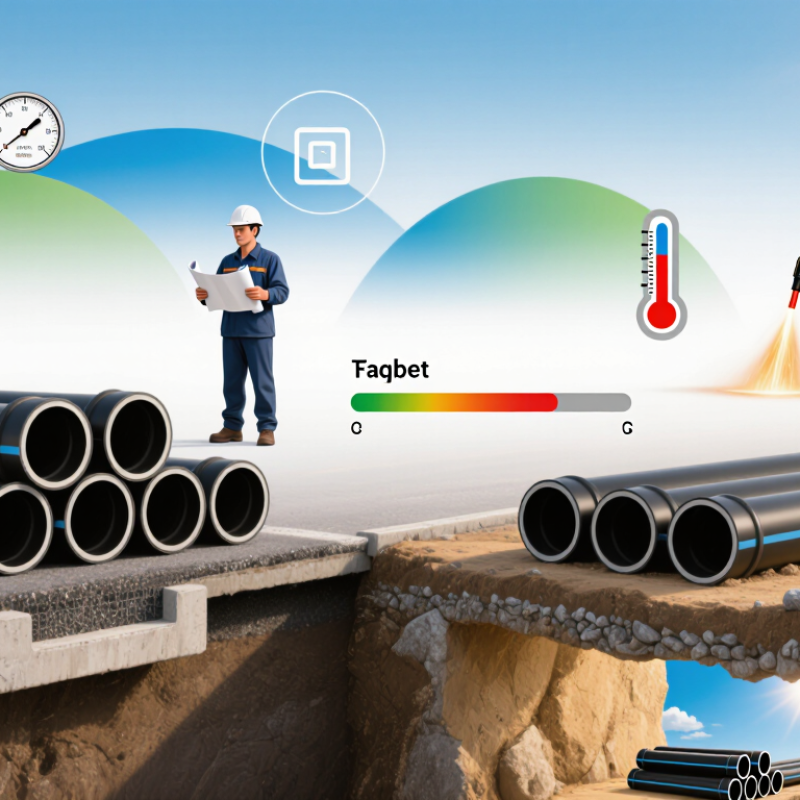
Define the application before comparing pipe dimensions or prices. Water systems need verified pressure ratings, potable-water approvals, and resistance to disinfectants. The U.S. Environmental Protection Agency’s 2023 Drinking Water Infrastructure Needs Survey estimates $625 billion in American drinking-water investment over 20 years. That scale makes service life and leak prevention practical purchasing priorities. A pipe may pass a pressure check yet fail through poor joining or unsuitable installation conditions.
Gas service demands different controls. Confirm the applicable national code, operating pressure, temperature range, and fusion qualification requirements. The U.S. Pipeline and Hazardous Materials Safety Administration reports extensive polyethylene use in gas distribution, but material selection still depends on traceability and approved procedures. Sewer applications often favor flexibility and corrosion resistance. However, deformation, surcharge loads, and long-term settlement require engineering checks, not guesses.
Mining and industrial service can be more severe. Slurry concentration, particle size, abrasion, chemicals, and cyclic pressure should guide the specification. The Plastics Pipe Institute’s Handbook of Polyethylene Pipe identifies temperature, surge, and installation conditions as key design factors. For mining, a thicker wall is not automatically the safest answer. Sometimes it increases handling difficulty without solving abrasion concerns. I would request flow data, soil information, joint details, and operating history before choosing. That extra review feels slow, but it can expose an unsuitable assumption early.
Choosing polyethylene pipe starts with matching the standard to the application, not simply selecting the highest pressure rating. PE4710 describes a high-performance polyethylene resin classification used for pressure applications. It helps engineers assess strength, slow crack growth, and long-term performance.
ISO 4427 covers polyethylene piping systems for water supply, including dimensions, performance, and testing. ASTM D3035 focuses on polyethylene plastic pipe dimensions and pressure requirements.
AWWA C906 addresses larger-diameter polyethylene pressure pipe for water and wastewater systems. These standards overlap in purpose, but they are not interchangeable. Check the required edition, design pressure, temperature, joining method, and local approval before ordering.
Tips: Ask for the resin designation, SDR, pressure rating, and test documentation. Confirm that fittings and fusion procedures match the pipe. Inspect the surface for gouges, flattening, or contamination before installation. Small defects can become serious under repeated pressure cycles. Field experience shows that poor handling often causes more trouble than resin selection.
Do not rely on a certificate alone. Review traceability records and installation conditions. A pipe may meet ASTM D3035 but still fail a project’s ISO 4427 system requirements. That detail is easy to miss. Temperature, surge pressure, soil movement, and disinfectant exposure also deserve attention. Standards guide the decision, but actual service conditions complete it.
Choosing polyethylene pipe in 2026 starts with pressure, not outside diameter. The Plastics Pipe Institute’s TR-4 data lists PE4710 with a 1,600 psi hydrostatic design basis at 73°F. That value is not the pipe’s operating pressure. Under ASTM D2837 practice, engineers apply a design factor, commonly 0.63, producing a 1,000 psi hydrostatic design stress. Using P = 2S/(SDR−1), an SDR 11 pipe rates near 200 psi at 73°F. SDR 17 rates about 125 psi, while SDR 21 rates about 100 psi. Lower SDR means thicker walls.
Check temperature, surge, and installation conditions. AWWA C906 design guidance and PPI technical publications emphasize that pressure capacity decreases as temperature rises. A line carrying water at 100°F needs a temperature adjustment, even when its pressure appears acceptable at 73°F. Surge pressure can also exceed steady-state pressure during pump starts or rapid valve closure. Measure the real operating envelope.
This is where my first sizing pass often fails.
Field experience shows that fittings, bends, and poor bedding can control performance before the pipe wall does. Confirm fluid compatibility, joining procedures, burial depth, and anticipated transients. Then verify the selected SDR against current engineering tables and local requirements. A neat calculation can still hide a bad assumption.
PE4710 has a hydrostatic design basis (HDB) of 1,600 psi at 73°F. Using a 0.63 design factor gives a hydrostatic design stress (HDS) of 1,000 psi. The chart shows the approximate pressure rating at 73°F for common SDR values.
Lower SDR values indicate thicker pipe walls and higher pressure capacity. Pressure ratings are calculated as P = 2 × HDS ÷ (SDR − 1), expressed in psi, and should be checked against applicable standards, temperature derating requirements, surge pressure, and installation conditions.
Choosing polyethylene pipe in 2026 requires more than checking pressure ratings. Joining and installation decisions often determine long-term reliability. Butt fusion creates a continuous joint when pipe ends are clean, aligned, heated, and pressed correctly. Allow the joint to cool without movement. Rushing this stage is a common mistake.
Electrofusion suits restricted spaces, repairs, and complex connections. The pipe surface must be scraped evenly and kept dry. Clamps should prevent movement during heating and cooling. Small contamination can weaken the joint.
Trench limits also deserve careful review. Soil type, groundwater, traffic loads, burial depth, trench width, and bedding affect performance. A trench that looks generous may still fail to provide enough side support.
Do not copy dimensions from another project without checking the design conditions. I have seen installation plans that seemed clear but ignored changing soil near the excavation. That detail needed a second review.
Tips:
Confirm the joining procedure before delivery. Check calibration records for fusion equipment. Keep pipe ends capped and clean. Measure trench depth at several points, not only near the access area. Leave room for safe alignment and inspection. When conditions differ from the drawings, pause and document the change. No checklist replaces site judgment.
Choosing polyethylene pipe in 2026 requires more than comparing purchase prices. A 50–100-year design life can reduce replacement work, traffic disruption, and excavation costs. However, design life is not a promise. Soil conditions, temperature, pressure cycles, installation quality, and chemical exposure still matter. A pipe buried beside a busy road faces different risks than one installed in stable, cool soil.
Hydraulic performance also affects life-cycle value. New polyethylene pipe commonly uses a Hazen-Williams coefficient near C≈150 for water-flow calculations. Its smooth interior can reduce friction losses and pumping energy. That difference becomes meaningful in long mains and continuous-duty systems. An engineer should verify the selected C value, pipe diameter, flow rate, and operating pressure. Small calculation errors can become expensive over decades. Keep records.
Field experience often reveals the overlooked details. Proper trench bedding, controlled backfill, clean fusion surfaces, and careful pressure testing protect the intended service life. Thermal expansion and contraction require attention above ground and near restrained connections. Surge conditions deserve separate analysis, especially where pumps start and stop frequently. One assumption may be wrong. Review it.
A sound comparison should include energy use, inspections, repairs, disposal, and future access. The lowest bid may not deliver the lowest lifetime cost. Yet a 100-year estimate can feel too confident without site-specific evidence. Ask for documented design assumptions, qualified installation procedures, and independent engineering review before approval.
| Evaluation Dimension | Polyethylene Pressure Pipe | PVC Pressure Pipe | Ductile Iron Pipe | Coated Steel Pipe |
|---|---|---|---|---|
| Typical design-life basis | 50–100 years when properly designed, manufactured, installed, and operated | Commonly 50–100 years under suitable service conditions | Often 75–100 years, subject to soil, corrosion, lining, and joint conditions | Potentially 50–100 years with suitable coating, corrosion control, and maintenance |
| Hazen–Williams roughness coefficient, C | Approximately 150 for a smooth, clean PE internal surface | Approximately 150 | Approximately 130–140, depending on lining and service age | Approximately 100–140, depending on internal condition and corrosion control |
| Hydraulic characteristics | Low friction losses; smooth bore helps retain hydraulic efficiency over time | Low friction losses and generally stable hydraulic performance | Higher friction than PE or PVC; internal lining condition affects flow | Hydraulic performance varies significantly with corrosion, lining, and deposits |
| Corrosion and chemical resistance | Does not rust; generally resistant to many waterborne chemicals, subject to compatibility checks | Does not rust; chemical compatibility must be checked for the specific service | Can be affected by aggressive soils and water; external protection may be required | Requires effective coating and corrosion-control measures in many environments |
| Jointing method | Butt fusion or electrofusion can create continuous, leak-resistant systems when performed correctly | Solvent-cemented or gasketed joints; installation must follow the applicable standard | Usually gasketed push-on or restrained joints; many joints are required along a route | Welded or mechanically joined; field coating and inspection may be necessary |
| Flexibility and ground movement | High flexibility; useful for directional changes and moderate settlement when properly designed | Less flexible than PE; requires attention to bedding, deflection, and joint movement | Rigid; thrust restraint, bedding, and joint design are important in unstable ground | Strong but comparatively rigid; movement control and corrosion protection are important |
| Leakage risk over the route | Potentially low because fusion can reduce the number of mechanical joints | Depends on solvent, gasket, installation quality, and long-term joint movement | Depends on gasket condition, joint installation, and ground movement | Depends on weld quality, coating condition, joints, and corrosion control |
| Installation considerations | Requires trained fusion personnel, controlled alignment, suitable temperature limits, and proper embedment | Requires careful handling, correct bedding, joint preparation, and temperature-aware installation | Heavier handling equipment is commonly needed; bedding and restraint details are critical | May require lifting equipment, welding controls, inspection, coating repair, and corrosion protection |
| Maintenance profile | Generally low routine maintenance; inspect exposed fittings, valves, transitions, and pressure performance | Generally low routine maintenance; monitor joints, fittings, and operational pressure | May require corrosion monitoring, coating review, and more frequent leak or joint assessment | May require coating inspection, corrosion monitoring, weld assessment, and periodic repairs |
| Life-cycle value drivers | Long service life, low corrosion exposure, reduced leakage potential, and low hydraulic friction | Long service life, low corrosion exposure, and relatively low friction losses | High structural robustness, balanced against weight, corrosion mitigation, and maintenance needs | High strength and custom fabrication, balanced against coating, welding, and corrosion-control costs |
| Best-fit selection signal | Strong candidate where flexibility, corrosion resistance, fusion joints, and long-term hydraulic efficiency are priorities | Strong candidate where rigid thermoplastic pipe meets project loading, installation, and temperature requirements | Consider where high stiffness, fire resistance, or established heavy-duty practices are required | Consider where high strength, high-temperature capability, or specialized fabrication is required |
© Copyright 2025 PolyFab Plastic Industry LLC. All Rights Reserved.