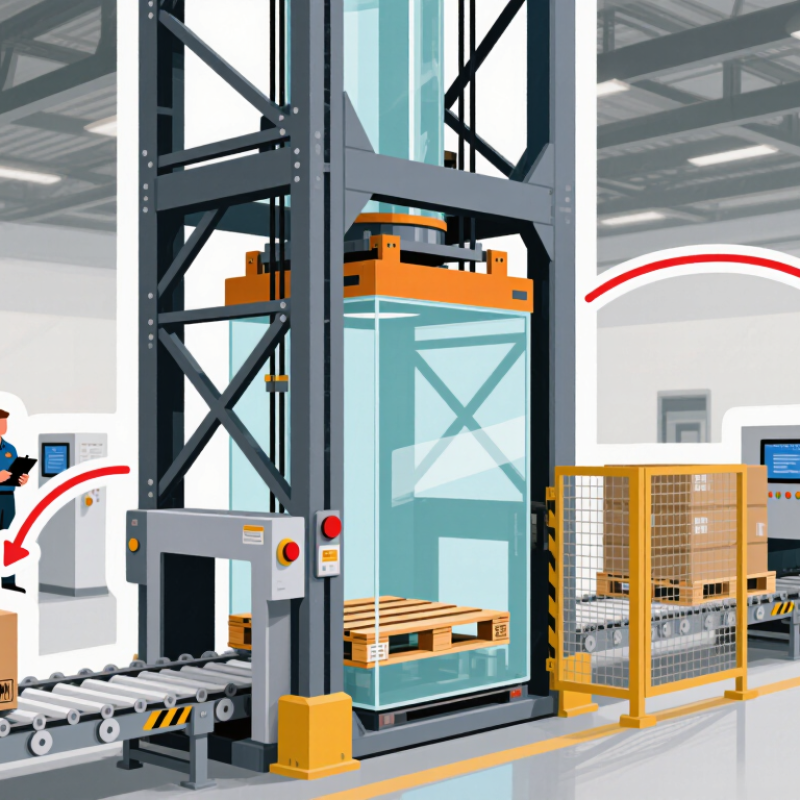
| 1. Application and Performance Definition |
| Carrying load | Define rated working load, pallet or container mass, load distribution, center of gravity, and foreseeable overload conditions. Example design input: 500–1,000 kg per platform. | Confirm that the rated capacity covers the heaviest intended load plus any defined dynamic effects. Check structural calculations and overload protection. | ISO 12100 requires reasonably foreseeable misuse to be considered during risk assessment. Applicable machinery and material-handling requirements should also be reviewed. | Select a system with documented capacity, stable load support, and protection against overload-related movement or structural failure. | Required |
| Vertical travel | Record the number of levels, floor-to-floor distance, usable travel, stopping positions, and required transfer height. Example travel range: 3–12 m, subject to design validation. | Verify that the travel envelope is separated from personnel areas and that every landing has controlled access and safe transfer conditions. | ISO 12100 supports hazard identification over the complete operating envelope. EN 619 and ANSI MH29.1 provide relevant safeguarding considerations for material-handling and vertical conveyor applications. | Travel height affects guarding extent, access points, emergency procedures, maintenance access, and installation requirements. | Verify |
| Throughput and cycle time | Define loads per hour, required acceleration and deceleration, loading time, unloading time, and acceptable queue length. Example target: 20–60 load cycles per hour. | Check whether the requested throughput can be achieved without increasing impact loads, stopping errors, or unsafe interaction at transfer points. | ISO 12100 requires risks introduced by operating modes and foreseeable use to be assessed, including automatic operation and material flow. | Higher throughput may require additional interlocking, presence detection, controlled restart, and traffic management. | Verify |
| Platform and load dimensions | Specify maximum length, width, height, overhang, wheel position, pallet condition, and load stability. Example platform envelope: approximately 1,200 × 1,200 mm; final dimensions are application-specific. | Confirm that the load remains fully supported and cannot contact guards, shafts, gates, sensors, or adjacent structures throughout travel. | ISO 12100 requires hazards caused by geometry, crushing, shearing, entanglement, and ejection to be assessed. | Platform dimensions should be based on the largest foreseeable load, not only the average load. | Required |
| Operating mode | Identify automatic, semi-automatic, manual, inspection, cleaning, and maintenance modes. | Each mode should have defined controls, access rules, speed limitations where necessary, and a documented restart procedure. | ISO 12100 emphasizes risk reduction through inherently safe design, safeguarding, and information for use. | A conveyor suitable for automatic production may require additional controls when manual loading or maintenance access is introduced. | Required |
| 2. Guarding and Access Control |
| Perimeter guarding | Guard the lift shaft, moving platform, drive components, counterbalance areas, and accessible pinch or shear zones. | Verify that fixed guards prevent access to dangerous moving parts during normal operation and that guards cannot be easily bypassed. | ISO 12100 establishes the risk-assessment and risk-reduction methodology. EN 619 addresses safety requirements for equipment and systems used for mechanical handling of unit loads. ANSI MH29.1 addresses safety requirements for vertical reciprocating conveyor applications. | Choose guarding based on actual access possibilities, load dimensions, maintenance tasks, and the complete movement envelope. | Required |
| Landing gates and doors | Provide a gate or door at every level where a person could access the platform or shaft. | Verify that access doors are interlocked so hazardous motion is prevented when a door is open. Check that opening a door stops or prevents movement as required by the risk assessment. | EN 619 and ANSI MH29.1 should be checked for application-specific access, gate, and interlocking provisions. ISO 12100 supports the selection of protective measures according to risk. | Every landing must remain protected, including levels that are used only occasionally or for maintenance. | Required |
| Interlock monitoring | Use monitored guard switches or equivalent protective-device arrangements appropriate to the assessed risk. | Test fault response, defeat resistance, restart behavior, and whether a single fault can allow hazardous motion. | ISO 12100 defines the overall risk-reduction process; control-system performance should be determined using applicable machinery-control standards and the risk assessment. | Interlocking should prevent unexpected movement rather than merely signal that a door is open. | Required |
| Openings and transfer points | Review gaps at conveyor interfaces, landing floors, transfer conveyors, gates, and platform edges. | Confirm that openings do not expose people to falls, crushing, shearing, trapping, or reach-through access during loading and unloading. | ISO 12100 requires assessment of mechanical hazards and access to danger zones. EN 619 is relevant when the lift forms part of a unit-load handling system. | Transfer interfaces frequently create hazards even when the lift enclosure itself is adequately guarded. | Required |
| Fall protection | Consider platform edges, open landings, elevated maintenance locations, and dropped-load scenarios. | Verify physical barriers, toe protection where applicable, safe access, load retention, and procedures for recovery of a stalled or misplaced load. | ISO 12100 supports evaluation of fall, ejection, and gravity-related hazards. Local building, workplace, and installation requirements may also apply. | Do not treat shaft guarding as a substitute for protection against falls at landing or maintenance areas. | Required |
| 3. Risk Reduction and Control Functions |
| Risk assessment record | Maintain a documented list of hazards, affected persons, operating modes, risk controls, residual risks, and verification results. | Check that risks are assessed for installation, commissioning, production, cleaning, fault recovery, inspection, maintenance, and decommissioning. | ISO 12100:2010 provides the internationally recognized methodology for machinery risk assessment and risk reduction. | A complete risk assessment is the foundation for deciding guarding, interlocking, controls, access, and user information. | Required |
| Emergency stop function | Provide accessible emergency-stop devices at operator stations and other locations identified by the risk assessment. | Verify stopping performance, reset behavior, prevention of automatic restart, and accessibility from foreseeable danger zones. | ISO 12100 identifies emergency stopping as a possible protective measure; detailed control and emergency-stop requirements should be verified against applicable machinery standards and local rules. | Emergency stop should not be used as the only means of preventing access to hazardous motion. | Required |
| Unexpected start prevention | Define safe states for power restoration, fault reset, door closure, sensor recovery, and control-system restart. | Confirm that closing a gate, restoring power, or clearing a fault cannot initiate an unexpected movement. | ISO 12100 requires risks from control-system behavior and foreseeable misuse to be considered. | Restart logic is particularly important on multi-level systems with several operators. | Required |
| Load presence and position sensing | Use sensors or equivalent controls to detect load position, platform alignment, gate status, and obstruction conditions where required. | Test sensor failure, misalignment, blocked sensors, overtravel, and incorrect load placement. | ISO 12100 supports risk-based selection of protective measures. EN 619 and ANSI MH29.1 should be reviewed for relevant conveyor and VRC safety provisions. | Sensors should support—not replace—physical guarding and safe mechanical design. | Verify |
| Mechanical stopping and overtravel protection | Provide defined upper and lower travel limits, stopping arrangements, and protection against overspeed or uncontrolled descent where applicable. | Verify normal limits, independent protective limits where required, braking performance, and safe behavior after power loss. | ANSI MH29.1 is a key reference for vertical reciprocating conveyor safety requirements; ISO 12100 provides the risk-reduction framework. | Vertical movement introduces gravity-related hazards that require dedicated mechanical and control safeguards. | Required |
| 4. Installation, Maintenance, and Compliance Evidence |
| Maintenance access | Identify lubrication points, drive access, inspection areas, platform access, and locations requiring isolation. | Verify lockout/tagout or equivalent energy-isolation provisions, safe access equipment, lighting, and clearance for maintenance tasks. | ISO 12100 requires hazards during maintenance, adjustment, and servicing to be assessed, not only hazards during production. | A design that is safe in automatic operation can remain unsafe if maintenance access is not engineered. | Required |
| Installation environment | Define indoor or outdoor use, temperature, humidity, dust, washdown exposure, corrosive substances, floor condition, and seismic requirements where applicable. | Confirm that materials, electrical enclosures, guarding, drainage, anchoring, and protective coatings suit the environment. | ISO 12100 requires the intended use and reasonably foreseeable environmental conditions to be included in the assessment. | Environmental conditions can change the suitability of sensors, brakes, guards, controls, and structural components. | Verify |
| Safety documentation | Request risk assessment, drawings, electrical schematics, operating instructions, maintenance instructions, inspection records, and conformity documentation. | Check that documents identify residual risks, protective devices, test methods, inspection intervals, and permitted operating conditions. | ISO 12100 includes information for use as part of the risk-reduction process. EN 619 and ANSI MH29.1 applicability should be documented for the selected configuration. | Documentation is essential for commissioning, operator training, periodic inspection, and future modifications. | Required |
| Standards applicability review | Confirm the applicable legal jurisdiction, adopted editions, machinery classification, site rules, and whether the equipment is integrated into a larger automated system. | Obtain a written compliance matrix showing which clauses or requirements apply and how each has been addressed or verified. | ISO 12100, EN 619, and ANSI MH29.1 have different roles and scopes; they should not be treated as interchangeable or automatically applicable in every jurisdiction. | Choose a supplier able to explain the standards basis for the complete installation, including interfaces with other conveyors. | Required |
| Factory and site acceptance testing | Prepare test cases for rated load, travel limits, gate interlocks, emergency stops, sensors, restart logic, fault conditions, and power-loss recovery. | Record test results, deviations, corrective actions, and final approval before production use. | Verification should demonstrate that the selected protective measures achieve the intended risk reduction under expected operating conditions. | Acceptance testing converts design assumptions into documented evidence of safe operation. | Recommended |