Choosing the right polyethylene pipe is not a simple matter of comparing prices. It requires practical judgment, technical knowledge, and attention to the environment where the pipe will operate. Diameter, pressure rating, temperature, fluid type, soil movement, joining method, and installation conditions all influence long-term performance.
Dr. William H. Krishnaswamy, a respected polyethylene piping researcher, has emphasized, “The performance of polyethylene pipe depends on the entire system, not the pipe alone.” That principle deserves attention. A pipe may look strong in a warehouse, yet fail to meet expectations when exposed to ultraviolet light, sharp bedding material, heavy traffic, or repeated pressure changes. The right polyethylene pipe must match the application, not merely the project budget.
Small details matter.
This guide presents ten practical tips for evaluating material grade, dimensional standards, pressure class, flexibility, chemical resistance, fusion compatibility, and supplier reliability. It also considers installation experience, certification, expected service life, and future maintenance. These factors can seem obvious, but they are often treated too casually during rushed purchasing decisions.
There is no perfect selection formula. Engineers may still face incomplete soil data, uncertain operating temperatures, or changing flow demands. That uncertainty should be acknowledged rather than hidden. A careful buyer asks difficult questions, checks technical documentation, and reviews field conditions before approving the product. Reliable decisions come from evidence, not attractive brochures or familiar brand names.
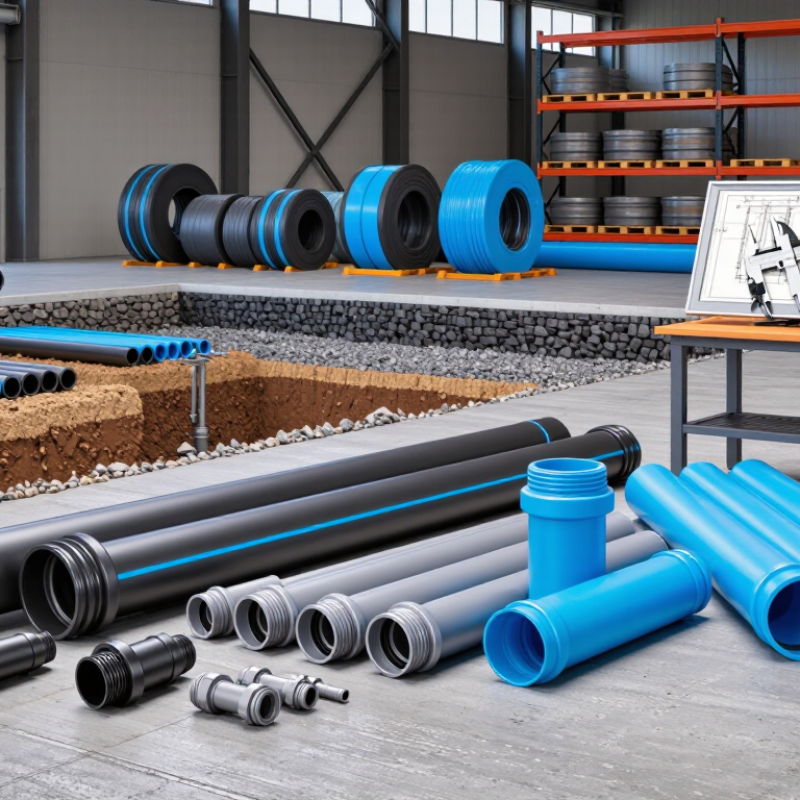
Choosing the right polyethylene pipe starts with service needs, not diameter alone. Record the required flow, operating temperature, pressure, fluid type, and expected service life. A pipe carrying chilled water may perform differently from one transporting warm process water. Site measurements matter. Guesswork does not.
MRS ratings provide an important material benchmark. Under ISO 9080 and ISO 12162, MRS 8 MPa generally identifies PE80, while MRS 10 MPa identifies PE100 at 20°C over a 50-year reference period. The Plastics Pipe Institute’s Handbook of Polyethylene Pipe explains that MRS is not the pipe’s allowable working pressure. Pressure capacity also depends on SDR, temperature, safety factors, and installation conditions. Check the design basis carefully.
Temperature deserves special attention. As service temperature rises, allowable pressure commonly falls, so a 10 MPa rating cannot be treated as a permanent operating limit. Flow calculations should consider internal diameter, roughness, velocity, and surge pressure. I have seen projects select a high MRS grade but overlook thermal derating. That choice looked efficient on paper. It was not fully evaluated. Leave room for transient pressure and future demand. A spreadsheet can still be wrong. Industry guidance from the PPI Handbook and ISO standards should be reviewed alongside project test data and qualified engineering judgment.
| Tip | Service Requirement | Reliable Reference Data | Selection Guidance | Check Before Ordering |
|---|---|---|---|---|
| 1 | Define the design flow | For water systems, a preliminary pipe velocity of approximately 0.6–2.0 m/s is commonly used. Higher velocities can increase friction loss, noise, and surge pressure. | Calculate the internal diameter from Q = A × v, then verify friction loss using the Darcy–Weisbach or Hazen–Williams method. Do not select nominal diameter from flow alone. | Record minimum, normal, and peak flow; operating hours; allowable head loss; and pump or gravity-system limits. |
| 2 | Separate pressure from flow requirements | Pipe pressure selection is governed by internal pressure, temperature, material strength, wall thickness, and safety coefficient—not by flow rate alone. | Choose a pressure class or SDR that remains suitable after temperature reduction and transient-pressure allowances are applied. | Include static head, pump shut-off pressure, elevation changes, control-valve closure, and possible pressure surges. |
| 3 | Interpret the MRS rating correctly | MRS means Minimum Required Strength at 20 °C for a 50-year reference period under the applicable classification method. MRS 8 MPa is generally associated with PE80; MRS 10 MPa with PE100. | Use MRS 8 or MRS 10 MPa as a material-class input, not as the allowable working pressure. The allowable pressure also depends on SDR, design coefficient, temperature, and standard. | Confirm the material designation, applicable product standard, pressure-design coefficient, and certification documentation. |
| 4 | Match SDR to pressure demand | SDR is the outside diameter divided by the minimum wall thickness. For water at 20 °C, an illustrative design coefficient of 1.25 gives approximate pressure classes: PE100 SDR11 = PN16, SDR17 = PN10, SDR21 = PN8, and SDR26 = PN6.3. | A lower SDR means a thicker wall and generally higher pressure capability, but also a smaller internal diameter for the same outside diameter. | Treat pressure values as design references only. Verify the exact rating under the governing standard and the pipe manufacturer’s technical documentation. |
| 5 | Assess operating temperature | Polyethylene pressure ratings are commonly based on 20 °C water service. Strength and allowable pressure decrease as continuous operating temperature rises. | For service above 20 °C, apply the temperature derating factors specified by the applicable standard. Avoid using a 20 °C pressure rating unchanged at elevated temperature. | Document minimum, normal, maximum, and occasional peak temperature, including heat from sunlight, buried conditions, and process fluids. |
| 6 | Check fluid compatibility | PE is widely used for potable water, raw water, wastewater, gas, and many industrial fluids, but compatibility depends on concentration, temperature, pressure, and exposure time. | Use a chemical-resistance reference and obtain project-specific confirmation for fuels, solvents, oxidizing chemicals, concentrated acids, and mixed chemical streams. | Provide fluid composition, concentration, pH, temperature range, density, viscosity, and cleaning or disinfection chemicals. |
| 7 | Allow for surge pressure | Rapid velocity changes can create water hammer. A simplified surge estimate is Δp = ρ × a × Δv, where ρ is fluid density, a is wave speed, and Δv is the velocity change. | PE’s flexibility can reduce surge magnitude compared with rigid materials, but it does not eliminate transient pressure. Select pipe and controls for the combined steady and surge pressure. | Model pump starts and stops, valve closure time, check-valve behavior, air release, elevation profile, and line length. |
| 8 | Consider installation conditions | PE pipe can be installed by trenching, directional drilling, sliplining, or above ground. External loads, soil conditions, bending radius, and thermal movement affect design. | Use the appropriate wall thickness and installation design for traffic loads, burial depth, groundwater, unsupported spans, and pulling forces. | Confirm soil classification, bedding, cover, frost conditions, minimum bend radius, allowable deflection, and joining method. |
| 9 | Select the joining system | Butt fusion and electrofusion can produce fully restrained, leak-resistant joints when the pipe and fittings are compatible and the procedure is controlled. | Select fittings, fusion equipment, and qualified operators for the pipe SDR, outside diameter, material classification, and site conditions. | Verify alignment, heating parameters, surface preparation, fusion records, pressure testing, and access for inspection. |
| 10 | Verify compliance and lifecycle needs | A technically suitable pipe should meet the applicable dimensional, material, pressure, testing, and health or safety requirements for its service. | Compare total lifecycle cost, expected service life, maintenance access, energy loss, repair strategy, and end-of-life handling—not only purchase price. | Request third-party certifications where required, batch traceability, dimensional test data, hydrostatic test results, and installation instructions. |
Engineering note: Pressure classes and temperature effects vary by standard, fluid, design coefficient, and application. Final pipe selection should be verified by a qualified designer using the governing project standard.


© Copyright 2025 PolyFab Plastic Industry LLC. All Rights Reserved.

