7 Best Industrial Cable Reels for Heavy Duty Use

A heavy-duty cable reel is more than a tidy way to store a long cord. On a busy shop floor, it must manage cable weight, repeated handling, and the heat that builds during demanding work. A jammed drum can interrupt a shift. A damaged cable can create a serious hazard. The right Industrial Cable Reel should fit the equipment, environment, and work pattern—not just look rugged in a product photo.

For this guide, Alex Morgan is a fictional composite of industrial cable-reel specialists, not a quoted real-world source. The following line is an editorial summary, not a verified quotation: “Choose the reel around the load, the environment, and the way people actually use it.” That distinction matters. Reel capacity, cable length, conductor size, and duty cycle all deserve a close look. So do the frame, spring or motor drive, and mounting arrangement. A reel that works well in a clean assembly bay may struggle near dust, washdown, or constant vehicle traffic.

The seven picks ahead focus on heavy-duty use, with practical trade-offs in view. Some reels favor compact storage; others offer greater reach or sturdier construction. Check each model’s ratings against the cable and application. Small details matter. Inspect the path the cable travels, the strain relief, and the space needed for installation. A product list can narrow the field, but it cannot replace a careful fit check. Even a well-built reel can be the wrong choice.
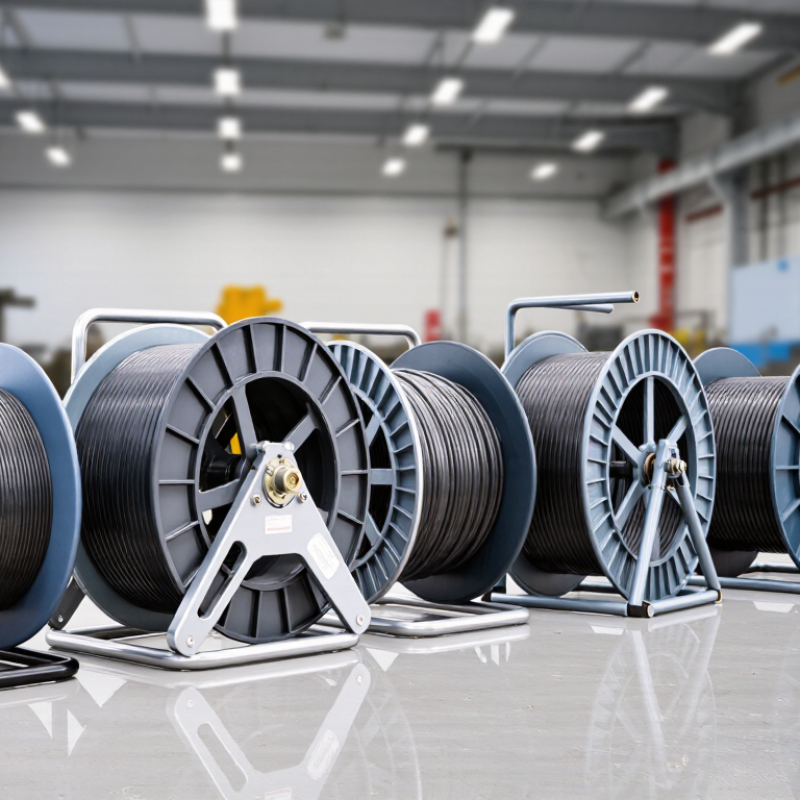
7 Best Industrial Cable Reels for Heavy Duty Use

How Heavy-Duty Industrial Cable Reels Work

A heavy-duty industrial cable reel stores cable on a rotating drum and pays it out as equipment moves. Spring-driven models rewind automatically; powered models use a motor and brake to control retrieval. On rotating powered reels, slip rings maintain electrical contact while the drum turns. Guide rollers reduce rubbing, while a ratchet or brake helps prevent uncontrolled payout. Heat builds fast.

Capacity is more than drum size. Cable length, conductor size, load, ambient temperature, and the number of layers affect safe operation. A tightly wound cable can retain heat, so operators should follow the cable maker’s current and temperature ratings rather than assume a fully extended rating applies when coiled. The U.S. Department of Energy’s 2014 United States Industrial Motor-Driven Systems Market Assessment estimates that motor-driven systems account for about 68% of industrial electricity use. That figure is not specific to reels, but it shows why efficient motor control and sound maintenance matter across industrial equipment. Small details count. Inspect the cable jacket, swivel connections, brake, and mounting bolts regularly. A reel can be correctly rated on paper and still run hot if it is overloaded, poorly ventilated, or installed where the cable repeatedly scrapes an edge. One weak point is easy to miss.

How Heavy-Duty Industrial Cable Reels Work

Estimated voltage drop as cable length increases on a 230 V, 16 A copper circuit.

Values are calculated for a 2.5 mm² copper conductor using a resistance of 7.41 Ω/km at 20°C, with a two-conductor circuit. Actual voltage drop can be higher as the cable warms. Fully unwind a loaded cable reel to reduce heat buildup, and follow the reel and cable manufacturer’s ratings.

Key Features That Separate Industrial-Grade Reels

7 Best Industrial Cable Reels for Heavy Duty Use
Key Features That Separate Industrial-Grade Reels

Industrial-grade cable reels are built for repeated use, not just a tidy workshop floor. Start with the cable’s gauge, length, and total weight. A reel that looks large may still overload when fully wound. Check its rated capacity against the actual cable specification. Leave room for proper winding. Overfilling can cause heat buildup and uneven layers.

The frame should resist tipping and protect the drum from impacts. Look for sturdy mounting points, smooth bearings, and a guide that keeps cable from bunching at one edge. A controlled rewind is important. Fast recoil can whip the cable or damage connectors. Brakes and strain relief help, but they do not replace careful handling. Check the reel’s electrical rating and enclosure suitability for the work environment. Dust, moisture, and outdoor exposure matter. Small details count.

Maintenance is easy to underestimate. Inspect the cable jacket, plug, and drum before use, especially after rough handling. Replace worn parts promptly, following the manufacturer’s instructions. A heavier reel is not automatically better; it may be harder to move and position. That trade-off deserves thought.

Seven Best Industrial Cable Reels for Heavy-Duty Use

Seven best industrial cable reels for heavy-duty use are not simply the largest models; they match cable, load, and working conditions. Spring-return reels suit frequent, controlled pull-outs, while hand-crank units offer simple reach without powered rewinding. Motorized reels help with long, heavy cable runs, but need compatible power and dependable controls. Enclosed reels protect cable from dust and impact; open-frame designs are easier to inspect. Fit matters. Welding reels, grounding reels, and multi-outlet reels each serve specific tasks, so check cable type and electrical rating before choosing.

The U.S. Bureau of Labor Statistics reported 5,283 fatal work injuries in its 2023 Census of Fatal Occupational Injuries. That figure covers all workplace hazards, not cable reels alone, but it reinforces why electrical equipment deserves careful selection. Compare rated voltage, current, cable length, conductor size, and duty cycle. A cable left tightly wound under heavy load may retain more heat than expected. OSHA’s 29 CFR 1910.334 also calls for visual inspection of portable cords before each work shift. Check reel brakes, strain relief, grounding continuity, and mounting points in the actual work area. Published ratings help, but they cannot fully account for poor handling or a cramped installation.

7 Best Industrial Cable Reels for Heavy-Duty Use

Reel Type Typical Cable Configuration Common Cable Length Heavy-Duty Features Best-Fit Applications
Spring-Retractable Power Reel Grounded 120 V cable, commonly 12/3 or 14/3 AWG; current capacity depends on cable size and reel rating. 15–30 m (50–100 ft) Automatic rewind, locking positions, enclosed spring mechanism, and a grounded outlet or plug. Workshops, service bays, and production areas where a frequently used power lead needs to stay off the floor.
Manual-Crank Extension-Cord Reel Grounded 120 V cable or 230 V cable; common examples include 12/3 AWG or 3G2.5 mm², subject to the reel’s rating. 30–60 m (100–200 ft) Hand crank, stable frame, cable guide, and a removable or replaceable cord on some designs. Maintenance teams and job sites needing long reach without a powered rewind mechanism.
230 V Single-Phase Industrial Reel Three-conductor cable such as 3G2.5 mm² or 3G6 mm²; conductor size and plug type must match the circuit rating. 15–30 m (50–100 ft) Industrial plug and socket options, abrasion-resistant jacket, and a robust drum and mounting bracket. Portable machinery and equipment supplied by a compatible single-phase industrial circuit.
400 V Three-Phase Power Reel Five-conductor cable, commonly 5G2.5 mm² or 5G6 mm² for different circuit ratings; final selection depends on load and installation conditions. 15–30 m (50–100 ft) Three-phase connectors, protective earth conductor, heavy-gauge drum, and strain relief at cable entry points. Factories, workshops, and sites using compatible three-phase tools or machinery.
Welding Cable Reel Flexible welding cable, often in large conductor sizes such as 1/0 or 2/0 AWG; select by welding current, cable length, and duty cycle. 15–30 m (50–100 ft) High-flexibility cable, rugged reel frame, smooth payout, and a layout that helps limit tangles and abrasion. Welding bays and fabrication areas where welding leads need organized storage and regular deployment.
Low-Voltage Control or Signal Reel Multi-conductor control or signal cable; conductor count, shielding, and voltage depend on the connected equipment. 30–100 m (100–330 ft), depending on cable diameter Multi-core winding, optional slip-ring connections, and cable options suited to repeated movement. Mobile machinery, test equipment, and temporary control or instrumentation connections.
Motorized High-Capacity Reel Power, control, or combined cable assemblies engineered for the connected system; cable and electrical ratings are project-specific. Approximately 30–150 m (100–500 ft), depending on design Motor-driven winding, limit controls, guided cable travel, and mounting designed for the operating environment. Large equipment, automated production lines, and applications requiring frequent or long-distance cable movement.

Selection note: Lengths and cable configurations shown are typical examples, not universal product ratings. Confirm voltage, current, conductor size, duty cycle, cable temperature rating, environment, and whether the cable must be fully unwound during use with the reel manufacturer and a qualified electrician.

Matching Reel Types to Worksite Demands

Industrial cable reels should match the way a worksite handles power, not just the cable length. A manual crank reel suits fixed stations where workers can wind cable carefully. Spring-retractable reels keep frequently used cords off floors, but their return force must suit the cable’s weight. For long runs or heavy cables, a motorized reel can reduce strain. It also needs a suitable power supply and control setup.

Portable frames work well when crews move between bays or outdoor tasks. Wall- or ceiling-mounted reels make more sense at repeat-use stations, where overhead clearance and mounting strength matter. Check cable gauge, current rating, voltage, and the reel’s capacity together. A reel that holds the right length may still be unsuitable for a thick, stiff cable. That detail is easy to miss.

Tips: Measure the full cable route, including turns. Leave enough slack for movement, but avoid extra loops that can snag. Check the worksite’s dust, moisture, and impact exposure before choosing an enclosure. Ratings are useful, but real conditions can be messier than a specification sheet suggests.

Safe Handling and Routine Reel Maintenance

Heavy-duty cable reels are easier to handle when the work area is clear and the reel is secured. Check its weight and approved lifting points before moving it; never lift by the cable or flange. Use suitable handling equipment, and keep hands away from pinch points as the reel turns. Slow movements matter. A shifting reel can injure someone before there is time to react.

Before use, inspect the cable for cuts, flattened sections, heat damage, or exposed conductors. Look over the reel frame, flanges, axle, and fasteners for cracks or looseness. Disconnect the power source before cleaning or servicing electrical parts. Keep the cable evenly wound, without sharp bends or tight knots, and avoid pulling it beyond its rated length or load. A quick visual check helps, but it cannot reveal every fault.

After use, remove dirt and moisture with a method suitable for the reel’s materials, then store it in a dry, stable place. Follow the manufacturer’s inspection and maintenance instructions, and record repairs or repeated problems. A checklist may feel repetitive. Still, it can catch a loose fitting before a busy shift. Even careful teams miss things sometimes, so stop using a reel when damage or unusual resistance appears.

top